
Why Do We Root for the Villain? The Curious Case of Sauron and Galadriel

What The Rings of Power reveals about our fascination with villains, forbidden romance, and the irresistible appeal of enemies to lovers.
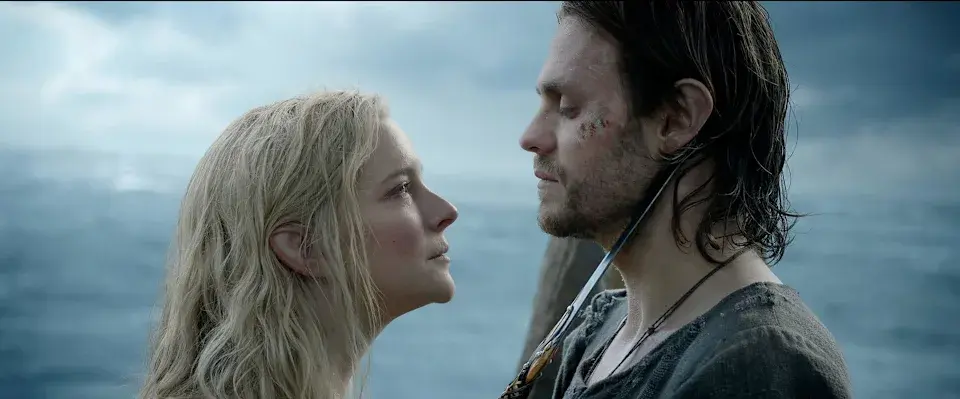
Contains spoilers for Seasons 1 and 2 of The Rings of Power.
I have a particular weakness when it comes to fictional villains, especially when they're written with enough complexity to make me momentarily forget that I'm supposed to be rooting against them. Give me a morally questionable character, an impossible romance, and two people who have absolutely no business being attracted to one another, and I'm probably going to be invested. I love a good enemies-to-lovers storyline, especially when the relationship is built on tension, conflicting loyalties, and the possibility that two people who should despise each other might actually understand each other better than anyone else.
But I'm also a Tolkien fan, which makes my fascination with the relationship between Sauron and Galadriel in The Lord of the Rings: The Rings of Power especially interesting.
I know who Sauron is. I know what he becomes, what he represents in Middle-earth, and how deeply his pursuit of power is woven into Tolkien's larger mythology. I'm certainly not watching the series under the impression that he's simply a misunderstood man who needs the right woman to change him. Yet I would be lying if I said I didn't understand the appeal of the romantic tension between him and Galadriel.
Apparently, I'm not alone. The relationship has inspired an entire corner of the fandom devoted to Haladriel, the pairing of Halbrand and Galadriel, complete with fan edits, theories, artwork, and plenty of debate about whether their connection should be interpreted romantically. On the other side are Tolkien fans who strongly oppose the pairing, often pointing to the characters' established histories and the fundamental differences between them.
I find myself somewhere in the middle, although perhaps a little closer to the romantics than Tolkien purists might appreciate. I can love Tolkien's original mythology, appreciate the creative liberties of an adaptation, and still enjoy the deliciously complicated possibility of a romance that was never meant to happen.
And I think that says something interesting about why we're so drawn to fictional villains in the first place.

The brilliance of introducing Sauron as Halbrand
One of my favorite creative decisions in the first season of The Rings of Power was introducing Sauron through Halbrand, a mysterious man with an uncertain past who becomes an unlikely companion to Galadriel.
For viewers familiar with Tolkien's mythology, Sauron is already an established figure of immense power and corruption. We know him as the Dark Lord whose ambition eventually threatens the entirety of Middle-earth. What makes Halbrand such an interesting introduction is that he gives this familiar villain an unfamiliar face, allowing the audience to encounter him through Galadriel's perspective rather than through the reputation he carries in the books.
Their relationship begins with mutual suspicion and gradually develops into an uneasy partnership. They challenge one another, share moments of vulnerability, and recognize qualities in each other that others might overlook. Galadriel sees someone capable of reclaiming a lost purpose, while Halbrand appears fascinated by her determination and the extraordinary force of her personality.
And the chemistry is difficult to ignore.
I think Charlie Vickers and Morfydd Clark deserve a great deal of credit for making their relationship so compelling. Their interactions have the kind of tension that romance readers immediately recognize. There's a push and pull between them, an emotional intensity beneath their conversations, and an almost instinctive understanding that makes their eventual conflict feel much more personal.
When Halbrand is revealed to be Sauron, the relationship becomes even more fascinating because the revelation changes how we understand everything that came before it.
As a Tolkien fan, I enjoyed the reveal for what it meant to the larger story. As someone who loves enemies-to-lovers romances, I also couldn't help appreciating the dramatic potential of discovering that the person Galadriel had grown closest to was the very enemy she had dedicated herself to destroying.
It's an extraordinary setup for a forbidden romance, even if that romance exists primarily in the interpretation and imagination of the audience.

The enemies-to-lovers trope was practically begging to be explored
There are few romantic tropes I enjoy more than enemies to lovers, and I think much of its appeal comes from the emotional intensity created when attraction and opposition exist simultaneously.
The characters aren't simply falling in love. They're confronting everything they believe about themselves and the other person. Their conversations become battles of wit, their disagreements carry emotional weight, and even the smallest moments of understanding can feel significant because they're happening between people who should have nothing in common.
Sauron and Galadriel take that dynamic to an almost mythological extreme.
We're talking about two immensely powerful beings whose histories and ambitions are tied to the fate of Middle-earth. Their conflict isn't based on a misunderstanding that could be resolved over a conversation. It involves opposing visions of power, responsibility, and the future of an entire world.
And from a storytelling perspective, I find that fascinating.
What makes the pairing especially appealing is that neither character is ordinary. Galadriel isn't a helpless heroine who needs rescuing, and Sauron isn't simply a dangerous man whose power makes him attractive. They are both formidable, intelligent, ambitious, and capable of challenging one another.
In romance, that kind of balance can be incredibly compelling. I love stories where the characters recognize each other's strength rather than one person existing solely to soften or redeem the other. The idea of two powerful individuals finding an unexpected connection, particularly when everything about their circumstances suggests they should be enemies, is exactly the kind of premise that makes the trope so popular.
Of course, Tolkien's story isn't an enemies-to-lovers romance, and I wouldn't want to pretend otherwise. But I also don't think appreciating the romantic possibilities of a fictional relationship requires us to misunderstand the source material.
Sometimes enjoying a pairing is simply about recognizing the potential for a different kind of story.

Why Sauron is such a compelling villain
Sauron is particularly interesting because Tolkien's mythology gives him a history that extends far beyond the familiar image of a Dark Lord seeking dominion over Middle-earth.
Before his corruption, Sauron was known as Mairon, a Maia associated with Aulë, the great craftsman among the Valar. His early qualities included an appreciation for order, structure, and the creation of things. Over time, those qualities became distorted by his desire to impose his own vision upon the world, eventually leading him into the service of Morgoth.
I think that background adds an important dimension to his characterization in The Rings of Power. Sauron isn't compelling simply because he's powerful or because Charlie Vickers happens to portray him with considerable charm. He's compelling because his motivations have a history, and because his understanding of what constitutes a better world has become inseparable from his need to control it.
The series explores that complexity through his different identities. Halbrand offers one version of Sauron, while Annatar reveals another, presenting himself as a figure of wisdom and generosity capable of inspiring trust.
There's something fascinating about a villain who doesn't rely exclusively on fear. Sauron understands how to appeal to people's ambitions, insecurities, and desires, and he can present himself as precisely the person they believe they need.
As a Tolkien fan, I appreciate seeing those qualities explored because deception and the corruption of good intentions are central to Sauron's character. As a romance fan, I also understand why that charisma makes him such an appealing subject for fictional relationships.
The two perspectives aren't mutually exclusive.
I can recognize Sauron as one of fantasy's great villains while still enjoying the complexity of his interactions with Galadriel. In fact, I think knowing his history makes their dynamic even more interesting because it adds an inevitable sense of tragedy to whatever possibilities we imagine for them.

Can a villain be romantic without being redeemed?
One of the recurring arguments surrounding Haladriel is whether interpreting their relationship romantically means overlooking Sauron's nature.
Personally, I don't think it does.
I think readers and viewers are perfectly capable of enjoying morally complicated fictional relationships without confusing them with examples of healthy real-world romance. Fantasy has always allowed us to explore extraordinary circumstances, including relationships built around danger, power, betrayal, and conflicting loyalties.
The appeal of an enemies-to-lovers story doesn't necessarily depend on one character becoming morally perfect. Sometimes it's the tension between two opposing forces that makes the relationship interesting.
And while I enjoy a well-written redemption arc, I don't believe every compelling villain needs one.
There's a tendency in romantic storytelling to imagine that love can fundamentally transform someone, and that certainly makes for an emotionally satisfying narrative when it's handled well. But I also enjoy stories where characters remain complicated, where their feelings don't erase their ambitions, and where the relationship itself creates as many problems as it solves.
Sauron and Galadriel are especially interesting in this regard because their connection can be interpreted through several emotional lenses. There's admiration, recognition, ambition, temptation, and the possibility of attraction. Those elements don't have to exist independently of one another, particularly in a fantasy story where the characters' experiences and motivations are so far removed from ordinary human relationships.
I don't need Sauron to become a good person to appreciate the possibility that Galadriel means something to him. Nor do I need Galadriel to abandon her principles for their relationship to be emotionally compelling.
In fact, part of what makes their dynamic so enjoyable is that neither character can simply become what the other wants.
That's where the tragedy lies, and I happen to love a good fictional tragedy.

The fandom debate is almost as interesting as the relationship
If there's one thing I've learned from following discussions about The Rings of Power, it's that Tolkien fans can be wonderfully passionate about the stories they love.
The Haladriel discourse is a particularly good example because it brings together audiences who approach the series from very different perspectives. Some are deeply invested in Tolkien's mythology and prefer adaptations that remain closely aligned with his established world. Others are drawn to the characters, performances, and relationships presented in the television series, including possibilities that exist outside the original narrative.
I understand both approaches.
Tolkien created an extraordinarily detailed mythology, and I think there's value in appreciating the care and complexity of his work. The relationships, histories, and moral foundations of Middle-earth are part of what make it such an enduring fictional universe.
At the same time, adaptations inevitably introduce new interpretations. They emphasize different elements, develop relationships that receive less attention in the source material, and occasionally create entirely new narrative possibilities.
As someone who enjoys both literature and screen adaptations, I don't necessarily expect the experience of watching a television series to be identical to reading the books.
I can appreciate them as related but distinct experiences.
And I think fandom becomes more enjoyable when there's room for those differences.
Some viewers will never see Sauron and Galadriel as anything resembling a romantic pairing, and that's perfectly reasonable. Others will continue creating fan fiction, edits, and alternate storylines that explore what might have happened if their relationship developed differently.
Neither approach prevents someone from appreciating Tolkien's world.
Personally, I enjoy the creativity that comes from fandoms taking established characters and imagining possibilities beyond the original story. It's one of the reasons I love fan fiction, particularly when writers explore relationships that are complicated, improbable, or entirely impossible within canon.
There's something wonderful about a fictional universe inspiring enough curiosity that people want to keep exploring it long after they've finished reading or watching the original story.
What makes their relationship so captivating?
For me, the most interesting aspect of Sauron and Galadriel's relationship is that they recognize something significant in one another.
Galadriel is powerful, determined, and deeply committed to her purpose. Sauron is equally formidable, possessing an extraordinary understanding of power and the ability to influence those around him. Their interactions are compelling because they exist on a scale that few other characters in the series can fully understand.
That shared intensity creates a dynamic that feels unusually personal, even when their goals are fundamentally opposed.
And I think that's where the romantic interpretation becomes especially appealing.
In many enemies-to-lovers stories, attraction develops because the characters discover that the person they considered an enemy understands them in unexpected ways. Their opposition forces them to confront qualities they might otherwise ignore, and the resulting tension becomes the foundation for a relationship.
Sauron and Galadriel offer a particularly dramatic version of that premise. They challenge each other's beliefs, recognize each other's capabilities, and share a connection that becomes more complicated as their true identities and intentions emerge.
The second season builds on that tension by allowing their conflict to become more direct.
Their confrontation carries the weight of everything that happened between them, and the emotional history established in the first season gives their opposition a different dimension than a conventional battle between hero and villain.
I think that's one of the reasons their scenes generate such enthusiastic discussion. The audience isn't simply watching two powerful characters fight. We're watching a relationship evolve from reluctant companionship into a deeply personal conflict.
And whether someone interprets that relationship as romantic, spiritual, psychological, or some combination of the three, there's plenty to appreciate about the storytelling.

Why we love the possibility of an impossible romance
I think the most appealing fictional romances often involve some degree of impossibility. There has to be something standing between the characters, whether it's circumstance, loyalty, timing, or their own conflicting desires.
The greater the obstacle, the more compelling the possibility of overcoming it can become.
Sauron and Galadriel represent an extreme version of that idea because their opposition is inseparable from the larger mythology of Middle-earth. We know their story cannot become a conventional romance without fundamentally changing the world Tolkien created.
But knowing that doesn't necessarily make the possibility less interesting.
If anything, it creates more room for imagination.
I enjoy the idea of exploring what might have happened under different circumstances, even when I have no desire to see those circumstances replace the original story. That's part of the pleasure of fantasy. It allows us to consider extraordinary possibilities without requiring every possibility to become canon.
And I think that's an important distinction in the conversation surrounding Haladriel.
Enjoying a fictional pairing doesn't mean demanding that the writers make it official.
Sometimes it's enough to appreciate the chemistry, enjoy the tension, and participate in the creative conversations surrounding the characters.
I don't need Galadriel and Sauron to end up together to enjoy their relationship. I simply appreciate that the series has given us a dynamic interesting enough to inspire so many interpretations.
So, why do we root for the villain?
I think the answer is that a well-written villain offers something that a straightforward hero sometimes cannot: the opportunity to explore contradictions.
We can admire a villain's intelligence while condemning their actions, appreciate their charisma while recognizing their ambition, and become fascinated by their relationships without believing those relationships should succeed.
Sauron is an excellent example because his appeal in The Rings of Power comes from the combination of his established mythology and the more intimate characterization offered by the series. We know the darkness associated with his future, but we're also given opportunities to understand the personality, motivations, and relationships behind that darkness.
And when you introduce a character like Galadriel, someone equally powerful and capable of challenging him, the resulting dynamic becomes especially compelling.
As a Tolkien fan, I have no desire to rewrite the fundamental story of Middle-earth. I appreciate the mythology for what it is, including the characters' established roles and the larger themes Tolkien explored.
But as someone who loves enemies-to-lovers romances, I can also appreciate the extraordinary fictional potential of Sauron and Galadriel.
I can enjoy the fan edits, understand the enthusiasm surrounding their chemistry, and entertain the possibility of a romance that exists outside the boundaries of canon. None of that diminishes my appreciation for Tolkien's work. If anything, it reminds me how much creative inspiration his world continues to generate.
Perhaps we don't always root for villains because we want them to win or because we believe they deserve redemption. Sometimes we root for the relationships, possibilities, and stories that emerge when a compelling villain encounters someone capable of challenging everything about them.
And if that happens to involve an impossibly powerful Dark Lord and an equally formidable Elven warrior, I can certainly understand why the internet is invested.


Comments